Loading...
Citation Checker
Paste a reference. Find out whether the paper actually exists — free, in seconds.
Try one:
Note: the above demo utilizes only a fraction of our engine, and is not accessing the full set of SourceVerify algorithms. This instant check answers one question: real or not found among scholarly works.
SourceVerify checks references against the real published record — confirming a source exists, and that every detail about it is accurate, not just correctly formatted.
When you sign up for a free or paid account, your searches check against whole reference lists and PDFs, blog posts, news articles, and international reports. It also repairs wrong details, and shows the evidence behind every verdict.
The full product
See SourceVerify in action
Whole reference lists, PDF uploads, repaired errors, and evidence for every verdict — watch it work.
AI writes citations that look right — and often aren't.
When a language model cites a source, it isn't looking anything up — it's guessing. Researchers keep measuring how often the guesses are wrong:
73.5%
Problematic references
of citations generated by major chatbots contained errors, omissions, or fabrications.
arXiv preprint, 202560%+
Confidently wrong
AI-powered news search engines collectively gave incorrect answers to more than 60% of queries.
Tow Center study, 202533%
Hallucinations in legal AI
Even specialized legal AI tools from LexisNexis and Thomson Reuters hallucinate up to this rate.
Stanford/Yale study, 2025Checkers ask for trust. Verification should be verifiable.
Everyone offers citation checking now — formatting tools, AI assistants, checkers built on the same technology that invents references in the first place. A checker that's wrong leaves you holding the bag.
Paste a fabricated citation into a free generator and it will format the fabrication perfectly — correct indentation, correct italics, correct APA. It has no mechanism for knowing the paper doesn't exist. It was never built to.
The fix isn't a more confident guess. It's verification you can independently confirm. Every SourceVerify verdict comes with its evidence — what we searched, what matched, links to the actual record — and the decision rules are published as an open standard, SVRIS, so you can check any outcome yourself. You don't have to take our word for it. That's the point.
Don't leave your reputation to probabilities.
Get started free
25 free checks. No card required.
How the full check works
No black-box confidence scores. Every reference gets compared against real evidence, field by field.
- 01
We extract every field
Title, authors, year, venue, DOI — parsed from each reference in your list or PDF, any style.
- 02
We gather real evidence
Searching OpenAlex, Google Scholar, and other sources for the actual work — scholarly papers, and with an account, blog posts, news articles, and reports too.
- 03
You get a verdict with receipts
Verified, verified with errors, needs human review, or unverified — with what matched, what didn't, and where we looked. Nothing is marked verified unless we find it.
What you get when you sign up
Start free — 25 checks
No card required. Paid plans go up to 1,500 checks and 1,500 citation formattings per month.
A whole reference list at once
Paste it, or upload the PDF — hundreds of references in a single pass.
Repair, not just flags
Wrong year, misspelled author, missing DOI — we tell you what is wrong and what it should say.
A clear verdict, with evidence
Verified, verified with errors, needs human review, or unverified — plus what we checked and what matched. When we can't confirm something, we say so. We don't guess.
Testimonials
Trusted by researchers & professionals
SourceVerify made the reference review process for our open call significantly faster and more reliable. We were dealing with a large volume of submissions, and the platform helped us efficiently verify references and quickly identify false or misleading entries that would have been difficult to catch manually. One of the most useful features was the ability to clearly see which references had supporting links and accessible source material versus those that did not. Having direct visibility into available links and verification status made it much easier to assess credibility at scale. The interface was straightforward to use, and the time savings were significant. It gave our team greater confidence in the integrity of the review process while reducing administrative workload. It's a particularly valuable tool for teams that need to review large numbers of applications or submissions while maintaining a high standard of due diligence.
JB
Janani Balasubramaniam
Program Management Officer · IDRC
In a scientific world where GenAI detectors often fall short, SourceVerify has become my go-to tool for verifying sources and identifying hallucinations. I highly recommend it to scholars, journal editorial teams, educators, and journalists as a powerful resource for combating illegitimate or dishonest writing.
CB
Dr. Carla Bonina
Associate Professor in Innovation and Entrepreneurship · University of Surrey
I've been using SourceVerify on some pretty extensive reference lists, and honestly, it's been a game-changer. Tracking down errors in hundreds of citations is tedious work, and this tool has cut that time down significantly. It's straightforward to use — no steep learning curve — and it catches things that are easy to miss when you're deep in a long document. I know the team is still building it out, and I'm looking forward to the additional features in the pipeline. It's already making a real difference, and I can only see it getting better from here.
BF
Babak Fayyaz-Najafi, Ph.D.
NextGen Decarbon Consulting
SourceVerify gave me the confidence to use AI assistance for literature reviews by providing a crucial verification layer that catches citation errors before submission. While drafting papers for Three Sisters and preparing a symposium manuscript on AI governance in education, the tool identified both minor typos and serious hallucinations, including references with correct authors but wrong titles, shifted publication years, and venues that didn't match actual journals. What could have been embarrassing citation errors (and time-consuming to correct!) became learning opportunities, and now I wouldn't trust AI-generated references without running them through SourceVerify first.
MO
Dr. Marcy O'Neil
Assistant Professor of Anthropology & Gender Equity and Social Inclusion Specialist, Global IDEAS · Michigan State University
In a world where it is increasingly difficult to tell fact from fiction, SourceVerify is an indispensable tool that saves me hours of time.
SC
Spencer Christopherson
Private Investor
SourceVerify made the reference review process for our open call significantly faster and more reliable. We were dealing with a large volume of submissions, and the platform helped us efficiently verify references and quickly identify false or misleading entries that would have been difficult to catch manually. One of the most useful features was the ability to clearly see which references had supporting links and accessible source material versus those that did not. Having direct visibility into available links and verification status made it much easier to assess credibility at scale. The interface was straightforward to use, and the time savings were significant. It gave our team greater confidence in the integrity of the review process while reducing administrative workload. It's a particularly valuable tool for teams that need to review large numbers of applications or submissions while maintaining a high standard of due diligence.
JB
Janani Balasubramaniam
Program Management Officer · IDRC
In a scientific world where GenAI detectors often fall short, SourceVerify has become my go-to tool for verifying sources and identifying hallucinations. I highly recommend it to scholars, journal editorial teams, educators, and journalists as a powerful resource for combating illegitimate or dishonest writing.
CB
Dr. Carla Bonina
Associate Professor in Innovation and Entrepreneurship · University of Surrey
Back to school
New semester, clean citations.
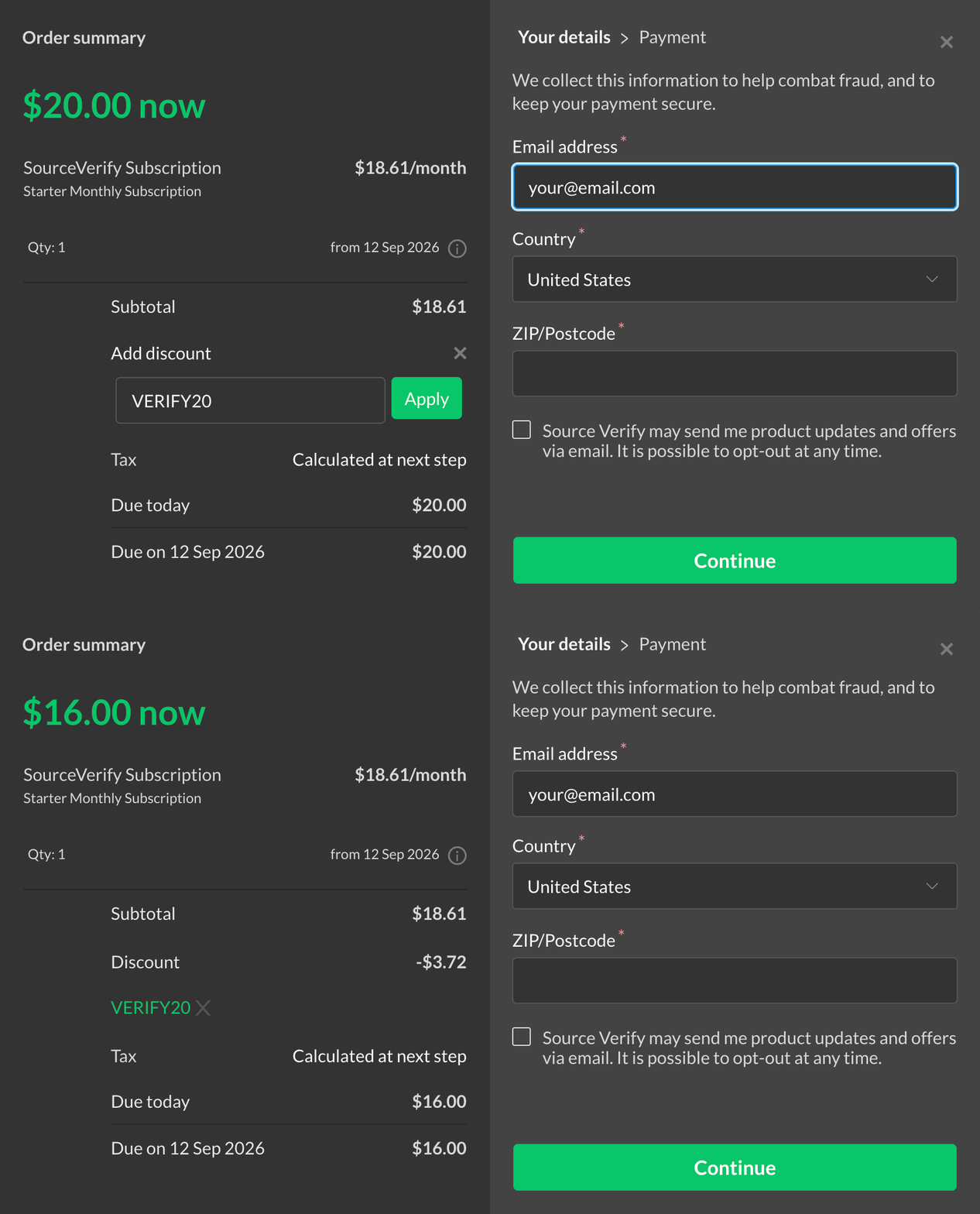
Papers and theses are ramping back up. Get ahead of it now — 20% off any plan, on us.
VERIFY20See plans — 20% off
Questions
- Is this free?
- The check above is free and needs no account. A free account gets you 25 checks on full reference lists, and paid plans go up to 1,500 checks a month.
- What does "not found" actually mean?
- It means we searched over 300 million scholarly works and nothing matched. Usually that means the citation was invented. Occasionally it means a real paper is not indexed. Either way, we will not call it verified.
- What do you check against?
- This quick check searches OpenAlex — over 300 million scholarly works. Your account goes further: it cross-references OpenAlex with Google Scholar and Google Search, and reads the pages a reference points to, before deciding.
- What does a full account do that this check doesn’t?
- A lot. It checks whole reference lists and PDFs at once, verifies blog posts, news articles, and international reports in addition to scholarly works, repairs wrong or missing details instead of just flagging them, and shows the evidence behind every verdict.
- How is this different from other citation checkers?
- Most tools either format citations or run an AI check and ask you to trust the result. SourceVerify shows its work: every verdict lists what we searched, what matched, and links to the evidence, and our decision rules are published as an open standard (SVRIS) — so you can confirm any outcome yourself.
- Can you check a citation from ChatGPT or Claude?
- Yes — that is the common case. AI tools produce references that look correct in every formal respect and refer to papers that were never written.
- Does it work with APA, MLA and Chicago?
- Yes. Paste the reference in whatever style you have it in.
- Can it check a whole paper?
- Yes, with an account. Paste a full reference list or upload the PDF.
Check your whole reference list.
25 free checks. No card required.
Nothing is marked verified unless we find it.